Horses and humans: A multicultural history
Having provided mobility and support that enabled and eased many human activities through the ages, horses have figured prominently in art, myth and pop culture.
Captured on cave walls ...
The Cosquer Cave in Marseille, France houses 500 paintings and engravings, rendered by humans of the Stone Age some 27,000 years ago, and 19,000 years ago respectively. Half of the artworks depict animals drawn in bold lines, such as bison, antelopes, ibex, seals and auks. But horses were represented the most. Pictured here is a replica of the cave drawing known as "The Panel of the Black Horses."
... and on canvas
Marc Chagall's "Le Cheval Bleu" ("The Blue Horse") is a dreamlike 1948 painting, featuring a blue horse whose mane is intertwined with a violinist's hair, a red rooster and a sleeping couple floating over a village under a moonlit sky. It symbolizes a fantastical, personal world of love, peace and mystical journeys, and features Chagall's signature use of vibrant color.
... or immortalized in terracotta
Uncovered in 1974 by farmers near Xi'an, China, "Bing Ma Yong" — "soldier and horse funerary statues" — refers to the famous Terracotta Army. This vast collection of life-sized terracotta figures of warriors, horses and chariots had been buried with China's first emperor, Qin Shi Huang, to protect him in the afterlife. This UNESCO World Heritage site showcases incredible ancient Chinese artistry.
Attaining mythical status ...
"Long" means dragon and "Ma" means horse in Mandarin. Thus, the Longma is a Chinese mythical creature with a horse's body and dragon-like features (scales, sometimes wings or a dragon's head). It symbolizes vitality and good fortune, and the phrase "long ma jing shen" meaning "dragon horse spirit," is used, among others, to remark upon older people who still exhibit youthful vigor and spirit.
... or legendary infamy
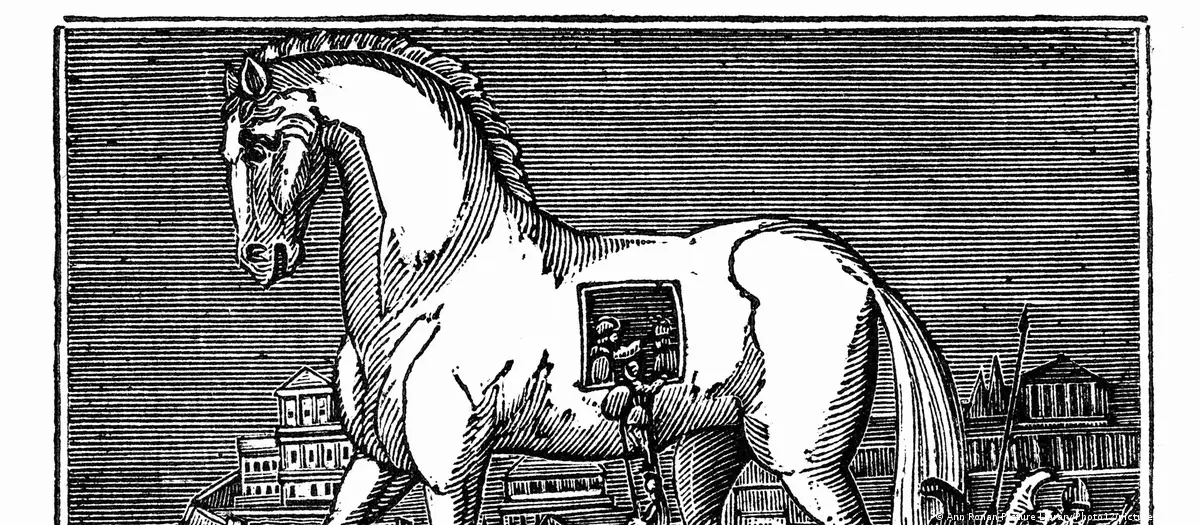
The Trojan Horse legend tells how the Greeks won the 10‑year war against the Trojans by tricking the latter into hauling a giant hollow horse inside their walls, unaware soldiers hid inside. They slipped out at night, opened the gates, and the Greek army stormed the city. The tale later inspired the name for Trojan‑horse malware that sneaks in through seemingly harmless downloads or attachments.
From announcing the apocalypse ...
True, the horses who bear the Four Horsemen of the Apocalypse may not be the main actors here. But together with their riders — representing conquest, war, famine and death respectively — they are the harbingers of the Final Judgement as described in the Bible's Book of Revelation.
... to pirouetting into our hearts
The Lipizzaner horses however can captivate you with their "dancing," performing highly skilled movements like jumps and pirouettes at the Spanish Riding School in Vienna. Rooted in military training, the tradition has evolved into the highest level of horsemanship where trained horses and riders achieve perfect harmony, executing complex maneuvers as a beautiful "ballet of the white stallions."
And ponies — both plastic...
Launched by Hasbro in 1982, they were originally called "My Pretty Pony" but were later rebranded as "My Little Pony." Besides being colorful and having names like Blossom, Butterscotch and Snuzzle, the defining feature of these toys is their colorful, brushable manes and tails. Creator Bonnie Zacherle was inspired by a real pony called Knicker, which she'd loved as a child.
... and metal
The Ford Mustang's galloping‑horse logo, created by designer Phil Clark, captured the untamed energy of the mustangs that have run free across the American West. When it debuted in 1964, Ford division chief Lee Iacocca — known as the "Father of the Mustang" — launched it as the first "pony car": an affordable, sporty coupe with youthful appeal, which targeted the young baby boomer market.