In India, a simple pair of glasses brings new hope
For less than $2, new vision aids are helping people in India see clearly again. A nonprofit is bringing eye care to underserved regions and opening up opportunities for education, employment and independent living.
Seeing clearly
For Indian vegetable vendor Tofan Jena, everything changed the moment he put on his glasses: for the first time, he saw the world in sharp detail. He received his first eye exam in Bhubaneswar, the capital of the eastern state of Odisha, at GoodVision, an organization dedicated to bringing eye care to underserved communities.
New perspective
The eye exam is free and open to everyone. For less than $2 (€1.70), Jena went home with a pair of glasses and a clear vision of his future. "I can read, I can write, and I can see very well at a distance," he repeats, as if trying to convince himself. "I'll be able to do everything with these glasses."
Global challenge
Jena is one of approximately 1 billion people who, according to the World Health Organization, suffer from vision problems but lack access to treatment. The charity GoodVision aims to bridge this gap and is active in 12 countries, including India, where approximately 550 million people need glasses and about 250 million have no way of obtaining them.
Access to medical care
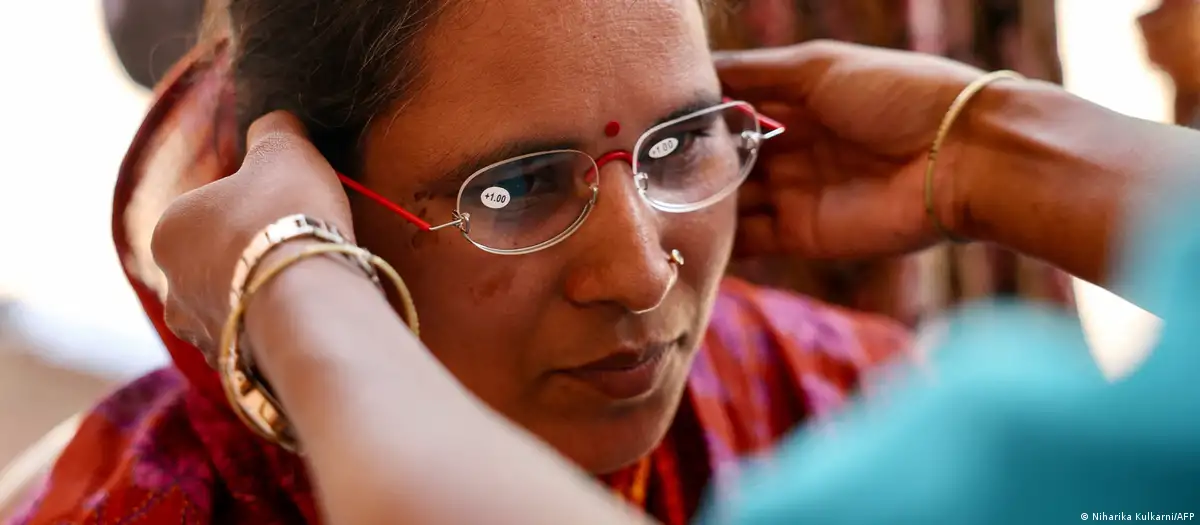
In the small town of Maniabandha, a two-hour drive from Bhubaneswar, patients wait on plastic chairs. Under a tent canopy that provides shade from the scorching sun, technicians from the aid organization set up a mobile clinic where they conduct eye examinations, vision tests and the selection and fitting of eyeglasses.
Mobile care in remote villages
"These community camps are extremely important for villagers, because they have no access to eye care," optometrist Gopinath Das told the AFP news agency. "Sometimes they don't have money, sometimes they don't even know they have eye problems." Every month, more than 400 underserved villages are visited ― places that are often overlooked by public health services.
Simple solution
The lenses for the glasses come from China, while the frames are made from metal wire in India and assembled in about 10 minutes. But the need is enormous: The International Agency for the Prevention of Blindness estimates that in India alone, preventable or treatable eye diseases result in productivity losses of around $30 billion.
One final test
With a pair of glasses perched on her nose, 43-year-old Minati Rout wraps up her visit with one final test: sorting small pebbles and grains of rice. "I was not able to read small letters, I was not able to thread in a needle, but now I can do all those things," she says. "I will tell my neighbors to get their eyes checked here too."
Social stigma
In Maniabandha, several patients were brought to the clinic for cataract surgery. Hospital director Srimant Kumar Mishra explains that the biggest challenge is motivating patients to undergo surgery. "There is a lot of social stigma, they are afraid. They have a feeling that [when] you get old, it is natural that they are not able to see," he said.
Large warehouse, enormous demand
At the GoodVision clinic, eyeglasses are sorted and stored. In the world's most populous country, where social inequality is widespread, the need is enormous. "In India, we only take things seriously if it's a matter of life or death," said Piush Khetan, the aid organization's director for India. "That's why we educate people and show them how important it is to take care of their eyes."