India news: Quad nations to surveil Indo-Pacific waters
Published May 26, 2026last updated May 26, 2026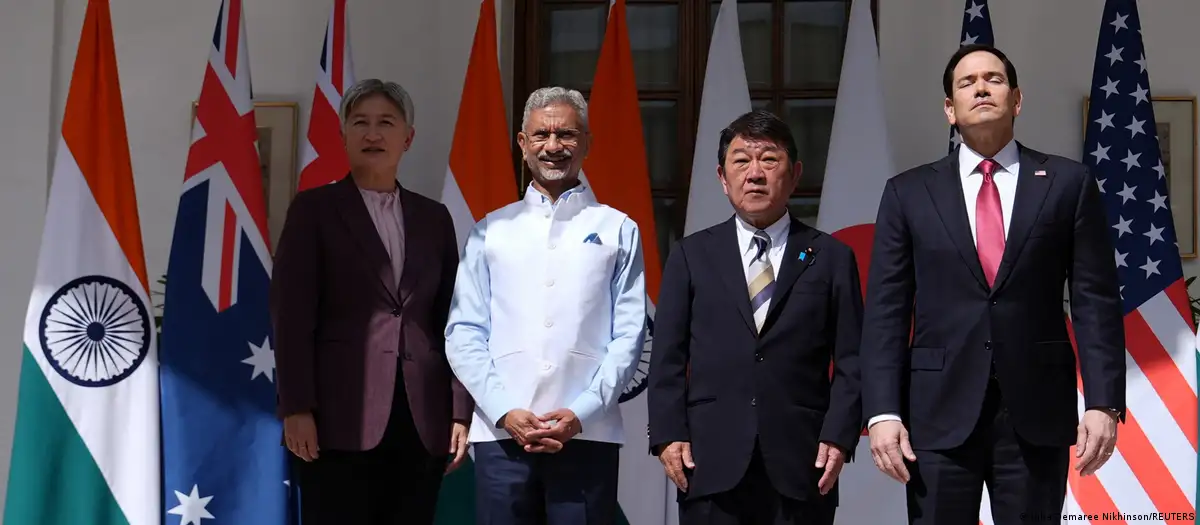
What you need to know
- Foreign ministers of the US, India, Japan and Australia meet in New Delhi
- Top US diplomat Marco Rubio announces critial minerals agreement among Quad nations
- Bharatiya Janata Party members marks 12 years of Modi as Prime Minister
- Indian weather agency warns of 'high probability' of heat wave in north, central India until June 4
It was a roundup of the biggest headlines from India on Tuesday, May 26. This blog is now closed.
Tired of missing our real-time updates? Click here to add us as a Preferred Source on Google. Then tap the "Star" or "Preferred" to keep DW News at the top of your feed.
Quad ministers 'seriously' concerned over South China Sea tensions
The US, India, Japan, and Australia, or members of the so-called "Quad" group of nations, voiced concerns over the East and South China Seas without calling out Beijing by its name.
"We remain seriously concerned about the situation in the East China Sea and the South China Sea. We reiterate our strong opposition to any destabilizing or unilateral actions, including by force or coercion, that threaten peace and stability in the region," US Secretary of State Marco Rubio and his three counterparts said in a joint statement after talks in New Delhi.
In clear but unstated references to China, the foreign ministers criticized "dangerous maneuvers by military aircraft" and "ramming and blocking actions in the South China Sea" and said they were "seriously concerned by the militarization of disputed features" in the waters where Beijing stakes wide claims.
What to know about East and South China Seas
The East and South China Seas are two distinct water bodies, and each of these contains land features claimed by China and at least one ally of the US.
To Beijing, the East and South China Seas are all part of its "near seas," and China continues to take steps to assert control over this space as one unified maritime periphery.
The disputed land features in these seas are small — islands, reefs, and rocks — but the maritime and security stakes associated with them are large.
The Quad group is also seen as a counterweight to growing Chinese influence and aggression in the Asia-Pacific region.
Elites vs the government: Delhi Gymkhana Club ordered to move, triggering legal battle
One of India's most exclusive private clubs, situated right next to the Prime Minister's residence, is gearing up for a legal battle with the Indian Government after it was asked to vacate the land it has occupied for over a century.
The Delhi Gymkhana Club was founded in British India in 1913 and has a waiting list of more than 30 years for new members. Its members include powerful business executives, military officers, and senior civil servants.
The club has previously clashed with the government over its management, but authorities on Friday issued a letter seeking to take back the leased land due to security and infrastructure needs.
At risk are the club's stately bungalows, manicured lawns, teakwood interiors, and large hallways.
In a lawsuit running to more than 900 pages, according to Reuters, a group of members and employees has asked the Delhi High Court to halt the move until the legal challenge is resolved.
The government wants to "illegally gain possession of a hundred-year-old institution in a period of 15 days," the lawsuit said.
At a hearing on Tuesday, the club's lawyer urged the court to prevent authorities from taking action, while the government's counsel argued that no eviction would take place without due process.
The next court hearing is set for July.
WATCH: How Iran war is crushing India's diamond industry
The Indian city of Surat, often called the global diamond capital, is under mounting pressure as geopolitical tensions disrupt one of India's most critical export industries.
The city — responsible for cutting and polishing the vast majority of the world's diamonds — is grappling with supply chain disruptions, rising shipping and insurance costs, and reduced demand in key markets.
Industry figures say sanctions on Russian diamonds and escalating Middle East conflicts have intensified an already fragile situation, forcing factory closures, layoffs and pay cuts. Workers report unpaid wages and growing financial stress, highlighting the human toll of a global trade slowdown.
Extreme heat ruins Alphonso crop in Maharashtra
The western Indian state of Maharashtra, a hub for producing renowned Alphonso mangoes, is reporting that hot weather has ruined this year's crop of the variety commonly known as the "King of Mangoes."
A sharp difference between daytime and nighttime temperatures in January hurt the flowering and fruit-setting process, while extreme temperatures through April and May spoiled the fruit itself, said Bapusaheb Manikrao Lambade, a government agriculture officer.
Temperatures in 2026 has been especially hot in India, likely due to the El Nino effect, a climate pattern that can trigger extreme conditions. A strong El Nino is expected this year, which will affect crops across Asia, South America and Africa.
A government-backed survey by scientists and field officials earlier this year, a copy of which was reviewed by Reuters, estimates this year's crop losses in Devgad at 85% to 90%. Devgad is one of Maharashtra's top Alphonso-growing areas.
The weather has also caused losses in mango-growing areas elsewhere in the state.
India's entire mango crop was worth $2.3 billion last year, according to Indian research firm Mordor Intelligence. The country is the world's largest mango grower.
Mass resignations shake Tamil Nadu's opposition party
Four opposition lawmakers in Tamil Nadu, a southern state in India, have resigned from their party in a major reshuffling of personal alliances in the aftermath of the recent state elections.
Three have already joined the newly formed ruling party led by actor-turned-politician Vijay, and the fourth is expected to follow.
The new chief minister's two-year-old party fell just short of a majority in the election, but he entered into a fragile coalition with just enough seats to prove a majority.
The defections effectively give the movie star a more stable grip on power.
DW DEBRIEF: Reading into the Quad's New Delhi meet
Fresh US strikes on Iran? Not a word
At the joint press statements by the four Quad foreign ministers in Delhi, three things stood out: there was no mention of Iran, no mention of China, and no clarity on whether there will be a Quad leaders' summit this year.
Which raises a bigger question: how relevant is the Quad in a moment of geopolitical upheaval, growing uncertainty and increasingly transactional partnerships, where even close allies are now openly pressured and bullied?
So what actually came out of today’s meeting?
The foreign ministers of Australia, India, Japan and the US announced plans to jointly build a port in Fiji. They also signed agreements on critical minerals and energy security.
The group reaffirmed its commitment to safe and unimpeded maritime traffic in the Indo-Pacific, especially for the flow of energy supplies, fertilizers, semiconductors and critical minerals. The ministers also repeated their support for freedom of navigation in what they called a "free and open Indo-Pacific."
But are statements like these enough to inject fresh momentum into a grouping that lost steam last year after failing to hold a leaders' summit?
One major reason for that slowdown was the tension between US President Donald Trump and Indian Prime Minister Narendra Modi over Washington's punitive tariffs and Trump's repeated claims that he brokered the India-Pakistan ceasefire after the two nuclear-armed neighbors came dangerously close to war in May last year.
And while US Secretary of State Marco Rubio used his four-day India visit for visible diplomatic repair work, repeatedly stressing the utmost importance of the US-India strategic partnership, Indian diplomatic sources continue to say that trust has been damaged. One visit alone is unlikely to undo months of perceived sidelining and pressure from Washington.
As for the Quad itself, today's announcements also included expanded maritime surveillance cooperation in the Indo-Pacific and a broader rollout of the Indo-Pacific Maritime Domain Awareness Initiative, which seeks to provide near real-time commercial maritime tracking data to regional partners. It’s clear that all four Quad countries share concerns about China's growing power.
But if today's meeting was meant to convincingly demonstrate why the Quad still matters in an increasingly unstable world, it may not have fully succeeded.
CNG price hiked, again
India's fuel retailers hiked the price of Compressed Natural Gas (CNG) once again on Tuesday, marking a fourth increase in less than two weeks.
Retailers increased prices by two rupees (2.1 US cents, 1.9 euro cents), according to the Press Trust of India. That's one US cent or less than two European cents.
The price of fuel differs in cities and states due to different levels of state tax and dealership commissions.
CNG is commonly used for public transportation in India. Autorickshaw and Uber drivers have reportedly been complaining that rising gas prices, along with Inflation and stagnant fares, are eating into their incomes.
Prices of petrol, diesel, cooking gas and CNG have all increased in India due to the US-Israel war on Iran.
Indians suffer in relentless heat
Millions of Indians continue to suffer extreme temperatures and their repercussions amid a days-long heat wave that has gripped most of the nation.
Indian media is reporting cases of water shortages in several cities and rural villages. Meanwhile, at least 16 have died in the southern state of Telangana amid hundreds of reported cases of heat stroke across the country.
Maximum temperatures have been reaching about 47 degrees Celsius (116 degrees Fahrenheit) in several regions, making conditions extreme for gig workers, construction labor, and service providers who depend on daily wages.
India's weather agency sees a high probability of heat waves Lasting till May 28 in several states across northern and southern India, including Punjab, Haryana, Madhya Pradesh, Uttar Pradesh, Maharashtra, Telangana, and Andhra Pradesh.
For the week after, the India Meteorological Department (IMD) shows a moderate probability of heat wave in Punjab and Haryana, and parts of Uttar Pradesh and Madhya Pradesh.
Jaishankar, Rubio sign bilateral framework on critical minerals
New Delhi and Washington have agreed on a bilateral framework for securing supplies of mining and the processing of critical minerals and rare earths, Indian Foreign Minister Subrahmanyam Jaishankar told the press on Tuesday.
The comments came as Jaishankar and Rubio signed the framework agreement in New Delhi.
"This is something we have also discussed today at the Quad meeting and whether we are doing it bilaterally, or in the Quad format or as a larger gathering of like-minded nations, it is something very timely and critical," Jaishankar said.
The Indian minister said the framework aims to deepen cooperation across the entire supply chain, including mining, processing, recycling and related investment.
"It will strengthen resilient and diversified supply chains, help us to collaborate on financing and with the effective management of critical minerals and rare earths,"
"It is one more sign of how close our cooperation is in a world where there are so many challenges but also so many opportunities," he said.
Quad nations agree on mineral sharing, Indo-Pacific surveillance and more
US Secretary of State Marco Rubio announced a slew of initiatives among the Quad nations to strengthen the group's dominance over the Indo-Pacific, including shared surveillance of the waters.
“I am very happy today…that we have real, concrete achievables that we can announce to our countries and the rest of the world,” Rubio said in New Delhi, calling the alliance a “partnership of action.”
The statement came after foreign ministers of the US, India, Japan and Australia gathered in New Delhi for a brief meeting on Tuesday morning.
The surveillance initiative is meant to integrate the four nations' surveillance capabilities and share near-real-time data on ship movements, including commercial ships.
Rubio also announced an Indo-Pacific energy security initiative aimed at strengthening regional fuel supply chains. The agreement takes on special importance amid the disruptions in energy supply due to the blockade of the Strait of Hormuz following US-Israeli strikes on Iran.
The US will host a Quad energy security forum later this year, Rubio said.
The group will also work with Fiji to upgrade port infrastructure in the Pacific islands, marking the Quad's first joint infrastructure project.
The four nations also agreed on a "Critical Mineral Framework," Rubio said at the joint briefing without elaborating further. "The framework will strengthen critical mineral supply chains in mining, processing, and recycling. Coordination across the Quad helps reduce vulnerabilities and supports long-term economic security." US Ambassador to India Sergio Gor said on X.
Ahead of the meeting, Rubio had said that Washington wants the Quad grouping to move beyond dialogue to one of action. The alliance is seen as a counter to China's growing influence and has grown in importance amid shifting geopolitical alliances and recent conflict.
"We are deeply committed to this partnership. It is a linchpin in a cornerstone of our global strategy as a nation," he said.
The four nations represent about 30% of the world’s GDP and nearly 2 billion people.
Speaking of the Strait of Hormuz, Australian Foreign Minister Penny Wong said the Indo-Pacific was facing "acute economic stress" and warned that any closure of the strait would have serious consequences for regional energy security.
"We recognize the importance of maintaining the principle of freedom of navigation and our opposition to any tolling proposition," Wong said, referring to Iran's plan to charge vessels passing through the Strait of Hormuz.
Welcome to our coverage
Good morning! And welcome to DW’s India news blog.
This is Mahima Kapoor from the New Delhi bureau, here to bring to you every major headline with all the context you need.
It has been a substantial morning in New Delhi with the foreign ministers of the US, Japan, Australia, and India – aka Quad – announcing a slew of initiatives to strengthen their dominance on Indo-Pacific maritime operations. That includes surveillance and data sharing agreements.
The US Secretary of State called the informal grouping a “partnership of action,” and all diplomats seemed elated with the results of the brief meeting on Tuesday morning.
Tuesday also marks 12 years of Narendra Modi as India's Prime Minister, a feat only previously achieved by India’s first Prime Minister, Jawaharlal Nehru. He has been a popular, yet controversial and divisive figure in Indian politics, but one who is still growing in his influence over India.
Meanwhile, much of the Indian masses continue to suffer heat waves with no relief in sight. As of Tuesday morning, 46 of the top 50 hottest cities of the world were in India, according to open-source pollution and weather tracking platform AQI.IN.
We have all of this and more. Stay tuned.