Iran war: Trump says ceasefire 'over' after fresh strikes
Published July 7, 2026last updated July 8, 2026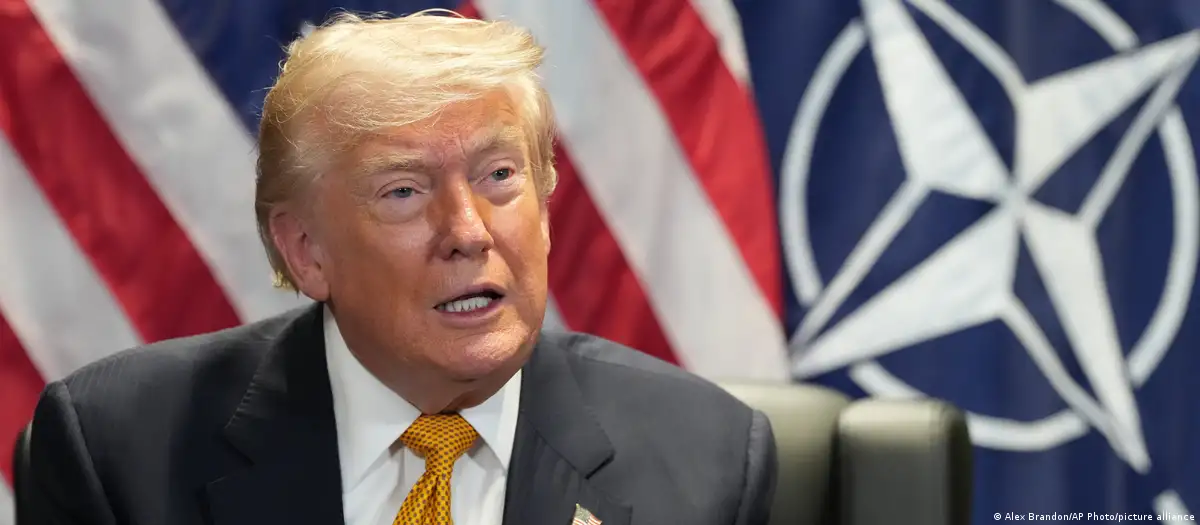
What you need to know
- Trump says interim truce accord with Iran 'over'
- US military says targeted dozens of Iranian military sites overnight
- Iran responded by striking US sites in Kuwait and Bahrain
- The US strikes came after Iran reportedly fired at 3 vessels in the Strait of Hormuz
Read below for the latest developments on the US-Iran conflict on Wednesday, July 8:
Tired of missing our real-time updates? Click here to add us as a Preferred Source on Google. Then tap the "Star" or "Preferred" to keep DW News at the top of your feed.
UN maritime head says nearly 6,000 seafarers 'stranded' in Gulf
Secretary General of the International Maritime Organization (IMO) Arsenio Dominguez has condemned attacks on ships transiting the Strait of Hormuz.
"These reckless attacks have again placed innocent seafarers in grave danger. No seafarer should have to risk their life simply for doing their job," Dominguez said in a statement.
He said there were nearly 6,000 seafarers "who remain stranded on board vessels unable to depart the Persian Gulf safely."
The IMO head urged all parties to "exercise maximum restraint" and to "deescalate the situation without delay."
The IMO began evacuating over 11,000 seafarers who had been stranded in the region after the memorandum of understanding was signed between the US and Iran to end the war.
According to UN figures, at least 14 seafarers have been killed in dozens of attacks since the war broke out.
EU advises airlines to avoid airspace of Iran, Iran and Lebanon
The European Union Aviation Safety Agency (EASA) advised airlines not to operate within the airspace of Iran, Iraq and Lebanon amid the latest escalation of hostilities between the US and Iran.
The advisories were valid until August 31, the EASA added.
The decision was based on an "ongoing high level of tensions and the potential for further military action."
The agency withdrew its previous bulletin that had also asked airlines to exercise caution when operating within the airspace of Bahrain, Kuwait, Israel, Jordan, Qatar, Oman, UAE and Saudi Arabia.
It is not yet clear whether new advisories would be issued for these countries.
WATCH: Trump says interim accord with Iran to end the war is 'over'
The US president says the interim peace deal with Iran is "over" and that he doesn't want to deal with the Iranian leadership anymore, calling them "scum" and "cuckoo." He made the remarks at the NATO summit in the Turkish capital Ankara.
Oil prices jump after Trump says ceasefire is over
Oil prices rose sharply after US President Donald Trump said the memorandum of understanding with Iran was over.
The price of Brent crude oil jumped over 5% to more than $78 a barrel while US benchmark crude spiked almost 6%, at one point even crossing the $75-per-barrel mark.
Prices had seen a drop since shooting up well over $100 a barrel following the outbreak of the US-Iran war in late February.
A reminder of the 14-point US-Iran peace plan
Under the agreement, signed in June, there would be an "immediate and permanent" halt of military operations on all fronts for 60 days, including Lebanon.
The two parties committed to "respect each other's sovereignty and territorial integrity and to refrain from interfering in each other's internal affairs."
The Strait of Hormuz, which had been under a crippling blockade would be gradually reopened.
Part of the agreement noted that Iran would "make arrangements using its best efforts" to allow safe passage of commercial vessels through the Strait of Hormuz for "60 days" with no charge.
The documents noted that traffic would start flowing "immediately," taking into account the need to remove "technical and military obstacles" and carry out de-mining operations.
Closure of the vital waterway has severely impacted the global economy.
Point 8 of the interim agreement deals with Iran's nuclear program and any ambition to develop nuclear weapons.
"The Islamic Republic of Iran reaffirms that it shall not procure or develop nuclear weapons," the memorandum of understanding (MOU) states.
Here are the key points:
- The US and Iran and their allies "declare the immediate and permanent termination of military operations on all fronts, including in Lebanon."
- The US and Iran "undertake to respect each other's sovereignty and territorial integrity."
- The US and Iran "commit to negotiating and achieving the final deal in maximum 60 days extendable with mutual consent."
- Immediately upon signing, the US will begin removing its naval blockade in the Strait of Hormuz and will fully end it in 30 days. Vessel traffic will be in proportion with pre-war traffic numbers.
- Iran will make arrangements for safe passage of commercial vessels with no charge for 60 days.
- The US and partners will undertake to develop a plan of at least $300 billion for the reconstruction and development of Iran.
- The US undertakes to terminate all types of sanctions against Iran.
- Iran reaffirms that it shall not procure or develop nuclear weapons. Iran is to down-blend its highly enriched uranium under the supervision of the International Atomic Energy Agency. Editor's note: But there is no clarity on whether Iran is required to give up the material or move it out of the country.
- Pending the final deal, the US and Iran will maintain the current status quo of its nuclear program and the US will not impose new sanctions or deploy additional forces.
- US Department of Treasury will issue waivers for the export of Iranian crude oil, petroleum products, and derivatives, and all associated services, including banking transactions, insurances, transportation, etc.
- The US undertakes to make fully available for use the frozen or restricted funds and assets of Iran.
- The US and Iran will agree that an executive mechanism will be established to monitor the successful implementation of this MOU and future compliance of the final deal.
- After signing, and subject to the beginning of the implementation of paragraphs 1,4,5,10 and 11 of the MOU, and the continuing implementation of these measures, the US and Iran will start negotiations regarding the final deal exclusively on the other paragraphs.
- The final deal will be endorsed by a binding UNSC resolution.
Trump says memorandum of understanding with Iran 'over'
US President Donald Trump says the interim accord to end the conflict with Iran is "over."
"As far as I'm concerned, it's over," Trump said at the NATO summit in Ankara when questioned as to whether the truce with Iran was now finished.
"It's just a waste of time dealing with them," Trump said, referring to the Iranian government and calling the leadership in Tehran "sick people."
He added that US representatives can continue negotiations, but said they would be "wasting their time."
Iran must understand 'serious negotiations' are needed: Germany
German Foreign Minister Johann Wadephul says the latest US attacks on Iran were warranted.
"Iran must now truly understand that serious negotiations are necessary and that further military strikes are warranted," Wadephul told German broadcaster NDR Info.
Wadephul said he did not believe the latest escalation in hostilities had undermined the ceasefire as the foundation for further talks between the US and Iran.
"I believe there is still a chance that these negotiations will actually take place," he said.
"This may be a show of force before the actual negotiations begin, and that is, of course, regrettable, because we finally need calm in the Strait of Hormuz," Wadephul said.
The strait must be "free" and "accessible" to international shipping, the German foreign minister stressed, adding that: "Iran is largely preventing that."
Khamenei's funeral procession crosses into Iraq
The funeral procession of slain Iranian leader Ayatollah Ali Khamenei has moved into Iraq's holy city Najaf.
Thousands of people have been accompanying Khamenei's coffin on his six-day funeral procession.
Najaf holds particular significance for Shiite Muslims because it is the burial site of Imam Ali, the cousin and son-in-law of the Prophet Mohammad.
The procession is expected to continue to the shrine city of Karbala before returning to Iran, where Khamenei is set to be buried Thursday at the Shiite imam tombs in Mashhad.
Iranian media report explosions in Bushehr
Iran's state-linked Mehr news agency reported there have been blasts in the port city of Bushehr, following the latest spike in hostilities between the US and Iran.
"Explosions have been heard in Bushehr and the surrounding area," the Mehr news agency reported without providing any further details.
Bushehr is situated in southwestern Iran and is home to the country's only civilian power plant near Kharg island, the main terminal through which 90% of the nation's crude oil exports transit.
Sirens in Bahrain sound for a third time, reports of explosions
More warning sirens have sounded in Bahrain amid the latest exchange of hostilities between the US and Iran.
"The siren has been sounded. Citizens and residents are urged to remain calm and head to the nearest safe place ," Bahrain's Ministry of Interior said in a post on X.
An AFP news agency correspondent reported that explosions were heard in Bahrain after the latest air-raid sirens sounded.
Iran said it struck Bahrain in retaliation for the United States bombing of Iranian targets overnight.
US strikes on Iran 'absolutely necessary,' says NATO chief
NATO Secretary General Mark Rutte has backed the latest US strikes on Iran, calling them "absolutely necessary."
"When you have a ceasefire and Iran is basically violating the ceasefire, we see what happened yesterday with ships being attacked, I think it is totally crucial that the US forcefully reacts," Rutte told reporters before a summit of NATO allies in Ankara.
The NATO chief also indicated that Iran would be on the agenda at Wednesday's talks.
"I expect allies today to reconfirm that Iran should never ever get its hands on a nuclear capability and secondly that the principle of the freedom of navigation, so the Strait of Hormuz completely opening up again," is essential, he added.
WATCH: What is Khamenei's funeral revealing about Iran?
As Iran holds six days of mourning for Ayatollah Ali Khamenei, massive crowds fill the streets. But the absence of his son, Mojtaba Khamenei, is raising questions about Iran's future leadership.
Iran says it targeted US military sites in Kuwait, Bahrain
Iran's Revolutionary Guards (IRGC) said they had targeted 85 US military sites in Bahrain and Kuwait in response to the US strikes in southern Iran.
The IRGC also said they downed a drone belonging to the US army in the country's south, according to Iranian media reports.
Sirens sound in Kuwait
Sirens warning of incoming attacks have sounded in Kuwait, the country's state news agency reported.
The Kuwaiti army said its air defenses are confronting "hostile" missile and drone attacks.
This comes after the US carried out strikes on Iran overnight.
Rocket sirens sound in Bahrain
Sirens warning of incoming attacks have been sounded in Bahrain.
"Citizens and residents are urged to remain calm and head to the nearest safe place," the country's Interior Ministry posted on its official X account.
Bahrain was often targeted during the joint US-Israeli war with Iran, with Iran launching rockets and drones at the nearby country.