Iranian nuclear inspections 'going to happen,' IAEA head
Published June 24, 2026last updated June 24, 2026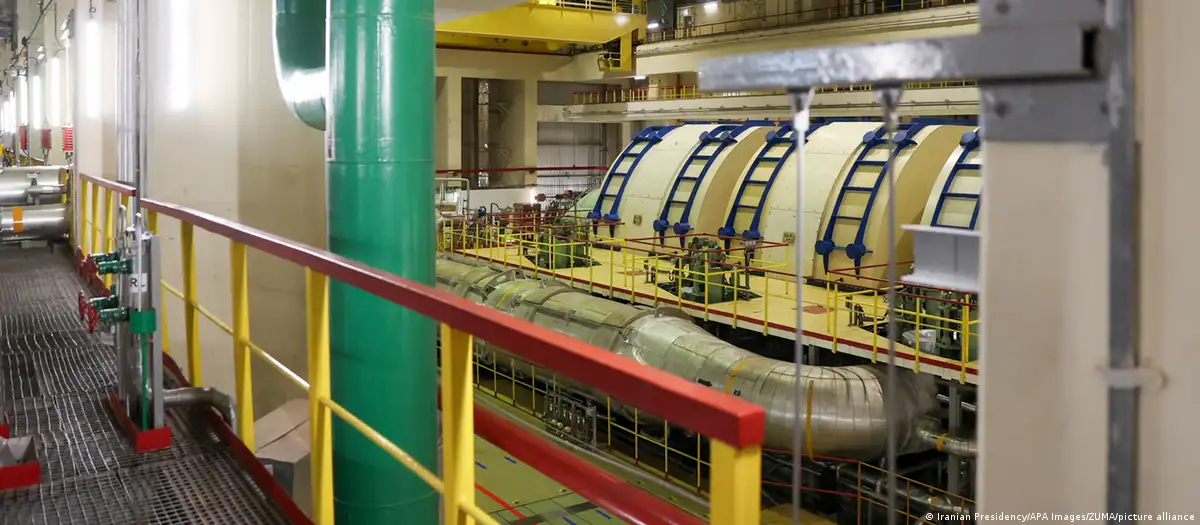
What you need to know
- UN nuclear agency boss says inspectors will visit Iran's nuclear sites under Iran-US interim deal
- Iranian lead negotiator calls deal with US 'America's declaration of defeat'
- US Secretary of State Rubio continues diplomatic trip to the Gulf
Keep reading for the latest developments on the Iran war and the wider Middle East on Wednesday, June 24, 2026.
Tired of missing our real-time updates? Click here to add us as a Preferred Source on Google. Then tap the "Star" or "Preferred" to keep DW News at the top of your feed.
Brent crude falls below $75 per barrel
The price of Brent North Sea crude oil, the international benchmark, continued to decline on Wednesday to trade under $75 a barrel for the first time since the start of the war in the Middle East.
Brent slid 3.1% to $74.73, extending its fall since the United States and Iran struck an interim agreement to end the conflict that began at the end of February.
At the beginning of 2026, a barrel of Brent crude cost $60.24. It hit a high during the war of $126.41.
Trump: Iran says 'no tolls' or fees to transit Strait of Hormuz
Iran informed the United States that it would not impose tolls, insurance costs or other charges of any sort on ships going through the Strait of Hormuz, US President Donald Trump wrote in a social media post, claiming reports to the contrary were "troublemaking Fake News."
"If this is false information, negotiations would end, immediately!" he added in the post.
Trump did not specify whether those assurances would remain in place after the 60-day negotiating period.
Oman had announced it would open a toll-free shipping passage through the strait and that Iran was considering a proposal for an environmental, navigation and security fee (see entry below).
Trump also said no Iranian funds under US control were being released to Tehran, but that it instead would be spent on US agricultural goods "desperately needed in Iran."
"We will be purchasing it for them exclusively from the United States," he wrote.
Iran minister says access to nuclear sites only after final deal
Iranian Deputy Foreign Minister Kazem Gharibabadi said Wednesday that UN inspectors would only be allowed access to Iran's attacked nuclear sites if negotiated as part of a final peace deal with the United States.
"In Switzerland, no meeting was held with [IAEA head] Grossi, despite his request. There is also no plan for access to the attacked facilities and nuclear materials," Gharibabadi wrote on X.
"These issues will only be discussed and resolved within the framework of a final agreement and as a result of the other party's practical action to lift all sanctions, etc."
Earlier Wednesday, Grossi had said such inspections would occur, but he did not provide an exact timeline (see entry below).
"Media noise cannot be used to impose facts on the ground," Gharibabadi added.
Israeli troops won't leave southern Lebanon, defense minister says
Israeli Defense Minister Israel Katz said that the Israeli military would not leave its positions in southern Lebanon.
"200,000 [Lebanese] residents will not return [to the homes they evacuated]. Because what happened in the past in security zones, where there was also a civilian population [present], was roadside bombs and attacks against the soldiers, and therefore we will not allow that," he said, according to The Times of Israel.
Earlier on Wednesday, there had been reports of a US-brokered "pilot" program for Israel's military to leave parts of Lebanon it occupies in the control of Lebanese forces (see entry below).
“We are not withdrawing,” Katz said, adding that the Israeli military would stay in the self-declared security zone in southern Lebanon "even if there is an American demand."
On Wednesday, the Israeli military said it attacked two armed Hezbollah militants it said posed a threat to forces in Lebanon.
Late Tuesday, Israeli Prime Minister Benjamin Netanyahu posted to X that the Israeli military would "continue to act with determination in order to neutralize threats against our soldiers and our citizens, demolish terrorist infrastructure, and maintain the security zone in southern Lebanon."
Oman opens temporary Hormuz toll-free shipping routes
Oman has said it is prepared to keep open shipping lanes through the Strait of Hormuz in coordination with the International Maritime Organization (IMO) and would not impose tolls on vessels passing through the narrow waterway.
Oman's Maritime Security Center wrote in a post on X that opening such a corridor aligns with the country's commitment to international law. It added that vessels using the waterway would need to coordinate with the IMO.
While the statement was clear on the issue of tolls, a diplomat speaking to Reuters news agency said Iran could still require ships to pay an environmental, navigation and security fee.
In an earlier joint statement, Iran and Oman said they will create a working group to study the issue.
Earlier this week, the US and Iran made conflicting claims on whether Iran would impose fees for passage through the Strait of Hormuz.
Israel, Lebanon discuss transfer of some southern territory to Lebanese army
Israel and Lebanon are in talks over a US-sponsored plan for the Israeli military to transfer control of parts of southern Lebanon it occupies to the Lebanese army, according to reports from Reuters, Al Jazeera and The Times of Israel, citing Israeli and Lebanese officials.
The proposal includes pilot areas which Israel would withdraw from; the Lebanese army would take over those areas and ensure that there was no Hezbollah presence, Al Jazeera said.
Lebanese troops involved would undergo US training and vetting to ensure they are not linked to Iran-backed Hezbollah. At the same time, Israel would maintain a military presence in a buffer zone along the border, according to Reuters' Israeli sources.
A senior Lebanese security official said discussions were ongoing in Washington and that Wednesday would see specific military-to-military discussions, including on the so-called transfer pilot zones, the news agency reported.
The Lebanese official said the discussions would focus on a timeline for the Israeli military's withdrawal and that any plan would emerge only after the scheduled end of talks on Thursday. The official did not respond to a request for comment on the Israeli officials' account of US vetting of Lebanese troops.
Ceasefire largely holds in Lebanon
A ceasefire has largely held since Sunday, even as Israeli forces are still stationed deep inside southern Lebanon, where they have taken control of a self-declared security zone, saying they need this to shield northern Israel from Hezbollah attacks.
An interim deal signed by Iran and the US last week requires both countries and their allies to declare an immediate and permanent end of military operations on all fronts, including Lebanon, and to ensure Lebanon's "territorial integrity and sovereignty."
The Times of Israel reported that the US-Iran deal infuriated Israel, which is not a party to the agreement and has argued that Iran should not have a say in what happens in Lebanon.
Hezbollah, a Shiite Muslim group established by Iran's Revolutionary Guards in 1982, has consistently demanded the Lebanese government's withdrawal from the US-backed talks with Israel.
Airlines should avoid Iranian airspace, EU agency warns
Despite an interim deal between the United States and Iran, the EU aviation safety agency (EASA) extended a warning for airlines to avoid airspace over Iran, Iraq and Lebanon to July 1. The agency also said airlines should "exercise caution" flying over Bahrain, Iran, Iraq, Kuwait, Israel, Jordan, Qatar, Oman, the UAE and Saudi Arabia.
While noting that an agreement between Washington and Tehran reduced the threat posed to aircraft flying in the region, it said short-term violations of the Memorandum of Understanding remain possible, particularly in and around the Strait of Hormuz and neighboring airspace.
"Given the ongoing high level of tensions and the potential for further military action, Iran maintains a high level of alert for its air force and air defense units nationwide, which creates an increased likelihood of misidentification," the agency said in a statement.
EASA also said the fragile ceasefire between Israel and Hezbollah did not eliminate the potential for military activity affecting the airspace of Lebanon.
"While the overall level of risk has decreased in the region, the sustainability of the ceasefire remains uncertain in the longer term, with a possibility of rapid escalation," it added. "Should the existing truce break down, the airspaces covered by this bulletin are likely to be exposed to imminent threats."
The conflicts in the Middle East have led many airlines to cancel flights to and from the regionas well increased ticket prices as the supply of fuel for planes, much of which typically travels through the Strait of Hormuz, dwindled.
US-Iran deal 'America's declaration of defeat' — Iranian parliamentary speaker
The interim agreement between Iran and the United States for a ceasefire in the Middle East war is "America's declaration of defeat," according to Mohammad Bagher Qalibaf, the head of the Iranian negotiating team.
"The Islamabad understanding was not the result of pressure and coercion, but rather the result of the resistance and authority of the brave Iranian nation," Qalibaf said on Wednesday at a conference in Azerbaijan. "The Islamabad Memorandum of Understanding became a declaration of America's defeat."
Qalibaf, whose comments were broadcast on Iranian television, said only the countries of the Middle East could ensure the region's security and that Iran was prepared to cooperate on the basis of "non-interference in internal affairs and respect for sovereignty."
He also stressed that the end of fighting in Lebanon was critical to Iran.
"For us, the ceasefire in Lebanon has been and is as important as the ceasefire in Iran, and the end of the war in Lebanon has been as important as the end of the war in Iran." Qalibaf said.
UN nuclear agency head says inspection in Iran 'going to happen'
The head of the International Atomic Energy Agency said inspectors would visit Iranian nuclear facilities as part of the interim deal signed by Washington and Tehran.
The statement from the UN nuclear watchdog IAEA head Rafael Grossi came a day after the US and Iran offered contradictory remarks on whether such sites would be inspected.
"I can understand political statements, they are part of the reality, but the fundamental thing I would like to remind you and draw your attention to is that there has been a Memorandum of Understanding, signed by both presidents," Grossi told journalists at a news conference.
He added that the agreement "says explicitly that the nuclear activities that are going to be carried out with the regards to the nuclear material facilities will be supervised by the IAEA."
"Obviously, to do that, we will have to inspect. Whether this happens the day after tomorrow or in one week or in 10 days, it's important, but not essential," he added. "This is going to happen."
Since a 12-day war on Iran by Israel and later the US in 2025, the IAEA has been blocked by Tehran from visiting Iranian enrichment sites.
Iran is believed to store enough highly enriched uranium to potentially build as many as 10 nuclear weapons, according to experts.
It is the world's only country with uranium enriched up to 60% purity without a weapons program. Tehran has long maintained that its program is for civilian use only.
Welcome to our coverage of developments in Iran and the Middle East
Hello, and thanks for joining DW as we follow developments in the war in Iran and the situation across the Middle East.
Today, we're starting with comments from the head of the IAEA on whether the agency's inspectors will have access to Iranian nuclear facilities as part of the interim deal signed by Tehran and Washington.
We will also be following US Secretary of State Marco Rubio as he continues a diplomatic trip to the Gulf for talks with US allies hit hard by the war in the Middle East.