The BKA — 'Germany's FBI' — turns 75
March 14, 2026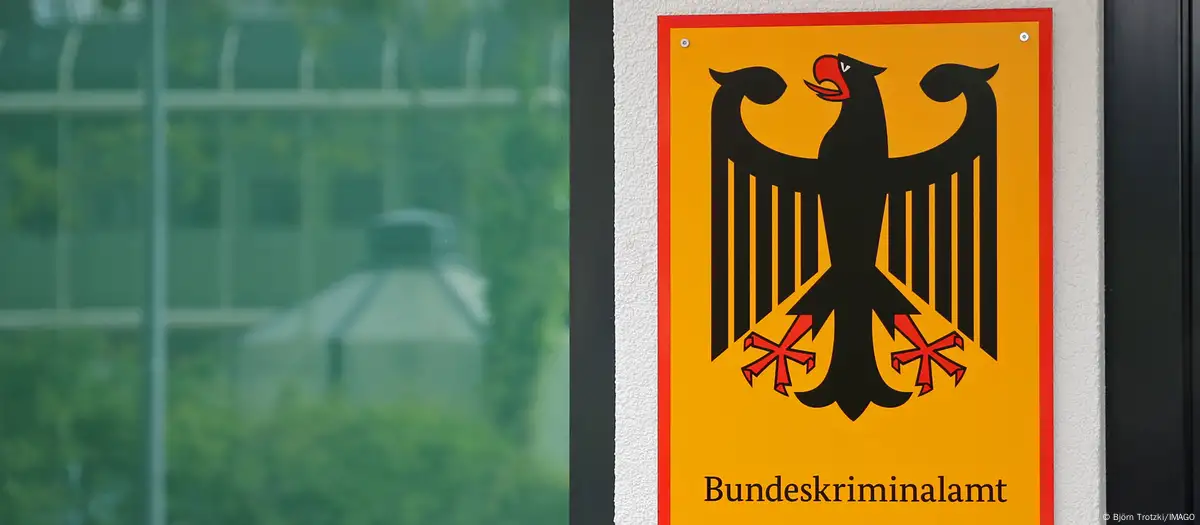
Transparency and self-criticism were long taboo at Germany's Federal Criminal Police Office (BKA). It wasn't until 2007 that the agency, Germany's central federal policy force, began to subject its own history to scrutiny.
Anyone visiting the BKA's website these days, as it marks its 75th anniversary, can read statements such as: "Until the late 1960s, the agency was shaped primarily by leaders who had been socialized under National Socialism. It was not until the generational shift beginning in 1969 that a fundamental transformation took place."
Nazis shaped German security forces
Founded on March 15, 1951 at its headquarters in Wiesbaden in the state of Hesse, the BKA was not an isolated case. Whether it was the judiciary, the military, or spy agencies the Office for the Protection of the Constitution (BfV) and the Federal Intelligence Service (BND) — all of the arms of the government in the early years of the new Federal Republic were riddled with former Nazis.
Former members of the National Socialist German Workers' Party (NSDAP) and the so-called Schutzstaffel, or SS, were responsible for the establishment of the BKA. Three-quarters of a century after its founding, the BKA has grown more open about its past.
"The BKA has been able to make an essential contribution to combating crime, i. e., maintaining internal security and preserving peace in a free, democratic Europe," a statement on its website reads.
In federally structured Germany, the BKA coordinates the policing of threats to national security in cooperation with the 16 state police offices. Its focuses are on political and religious extremism, drug trafficking, international terrorism and cybercrime. The BKA is also responsible for protecting important individuals — from the chancellor and federal president to state guests.
One of the biggest tests for the agency was the era of left-wing terrorism that began in 1968, when the Red Army Faction (RAF) kidnapped and murdered several public figures well into the 1990s. Victims were often high-ranking business executives, perhaps most famously the president of the employers' association, Hanns Martin Schleyer.
More funding, more personnel
Politicians responded to the expansion of these various threats with a massive expansion of the BKA, which currently has a budget of €1.24 billion ($1.43 billion). Between 1970 and the turn of the millennium, the agency's staff nearly quadrupled — from around 1,200 to more than 4,500. Over the following 25 years, the number continued to rise sharply to just under 9,400 employees today. The decisive factor in this was the Islamist terrorist attacks of September 11, 2001, in the US.
Since then, Germany has continuously strengthened all its security agencies. The Joint Counter-Terrorism Center (GTAZ), established in Berlin in 2004, plays a central role in this effort. There, the BKA sits at the same table with experts from state criminal investigation offices, the federal police force responsible for border security, the Customs Criminal Investigation Office, the intelligence services, and the Federal Office for Migration and Refugees (BAMF).
Espionage, sabotage, right-wing extremism
The Office of the Federal Prosecutor General (GBA) also has a seat at the GTAZ, an agency that has the power to commission the BKA to conduct investigations, usually concerning suspected terrorism, espionage, and sabotage. BKA findings frequently lead to indictments and convictions. One famous case that attracted international attention was the murder of a Georgian man found shot dead in the heart of Berlin in 2019. The court found that the perpetrator, who was sentenced to life in prison, had acted on behalf of the Russian government.
Another focus of the BKA is the fight against right-wing extremism. When the terrorist group known as the National Socialist Underground (NSU) was uncovered in 2011, the BKA took over the investigation, which found that the NSU was behind a series of murders that had long remained unsolved. Nine men with immigrant backgrounds and a female police officer had been murdered by the NSU.
A parliamentary investigation at the time described the fact that the NSU was able to remain undetected for 13 years as a "total state failure," a criticism directed primarily at Germany's security agencies, including the BKA. One consequence was the establishment of the Joint Center for Countering Extremism and Terrorism (GTEZ) in 2012. The similarity in name to the GTAZ is no coincidence, as police and intelligence agencies work closely together in both centers.
The BKA is well-connected internationally as well, particularly with the European Union's police agency, Europol. Key areas of focus include the fight against terrorism, organized crime, child abuse, as well as human trafficking. The BKA also has liaison officers in more than 50 countries. As a rule, they are organizationally integrated into German embassies abroad.
AI at the BKA
On the occasion of its 75th anniversary, the BKA looks back on an eventful history and faces greater challenges than ever in today's digital age. At a ceremony in Wiesbaden this week, Chancellor Friedrich Merz promised to further strengthen the BKA and other security agencies.
"Internal security and external security can no longer be separated," the chancellor declared.
Criminals at home and abroad are also increasingly using artificial intelligence (AI), which is why BKA President Holger Münch has long been calling for more powers. Interior Minister Alexander Dobrindt intends to grant him this wish and enable the use of the US surveillance software Palantir, despite concerns about becoming dependent on a US company.
The Left Party warns against mass surveillance
There are also plans to deploy an AI-based program for biometric facial recognition, something that the opposition Left Party in the Bundestag has warned against: "This type of digital expansion is hardly compatible with European law and endangers everyone's freedom," said Clara Bünger, the party's domestic policy spokesperson.
There have already been several lawsuits against the BKA over the issue. The Federal Constitutional Court most recently ruled in 2024 that the surveillance of contact persons of suspects is partially unconstitutional. The BKA Act has since been reformed to better protect the rights of those potentially affected.
This article was originally written in German.
While you're here: Every Tuesday, DW editors round up what is happening in German politics and society. You can sign up here for the weekly email newsletter, Berlin Briefing.