Ukraine war medics struggle to maintain mental stability
At a retreat in the Carpathian Mountains, Ukrainian front-line medics receive psychological support far away from the fighting. But even in moments of calm, the war is ever-present — in conversations, games and memories.
'You remember each one'
Ukrainian paramedic Roma Zukh learned a hard lesson during the Russian invasion: Don't get too close to colleagues, as they could be killed at any moment. Since Russia launched its invasion in February 2022, the former truck driver has seen many friends die, and doesn't want to watch others suffer the same fate.
Retreat in the Carpathian Mountains
More than a thousand kilometers away from the war, in the Carpathian Mountains in western Ukraine, Zukh's goal to maintain his distance is shaken during a 10-day retreat. At first glance, the so-called RePower Program looks like a summer camp: pottery, hiking and sushi classes. But it's about more than that — it's about allowing closeness again. Some find this more difficult than others.
Focus on the essentials
At the retreat, pottery helps the medics to take their minds off things. They focus solely on their hands, the material and the sensitivity required to shape the clay. The stresses of war, the images, sounds and smells of the front line, are far away for a moment.
Instant relief
Dmytro Kunytskyi sits in a seminar room and recalls his arrival at the retreat. Driving into the mountains, amid bright, autumnal orange and green trees, the 20-year-old medic was struck by a long-forgotten feeling. "We opened the windows and the air filled with the smell of pine," he said. "We were just very happy, like little kids." But completely leaving the front line behind is hard.
How to work with ongoing trauma?
Psychologists working with the medics at the camp face a difficult challenge. Most will soon go back to the front, making in-depth therapy hard. "To delve into trauma, we need time to stabilize people," doctor Andrii Anpleiev told news agency AFP. "This is something new ― working with trauma when the traumatic conditions are still ongoing."
Regulating emotions
Instead of deep therapy, psychologists teach the paramedics specific techniques to regulate their emotions and create safe spaces. In the photo, around a dozen emergency responders relax to the sound of ocean waves and birdsong during a "sound healing" session — until loud snoring breaks the silence: Roma Zukh has fallen asleep.
Tuning out vivid flashbacks
Kunytskyi is trying to relax at the retreat. But he's frequently on the phone, coordinating his team on the front. For two years, he's been retrieving and examining the bodies of comrades killed in battle. "I get flashbacks. Times when the smell of blood is so sweet that you feel poisoned, when you don't have any chance to immediately wash it off… With every breath you take, you smell blood."
Breaking through isolation
Programs such as RePower strengthen the sense of belonging, break through isolation and promote trust. Interacting with people who have had similar experiences helps many to process stress and gain new mental stability for redeployment on the front lines.
War is omnipresent
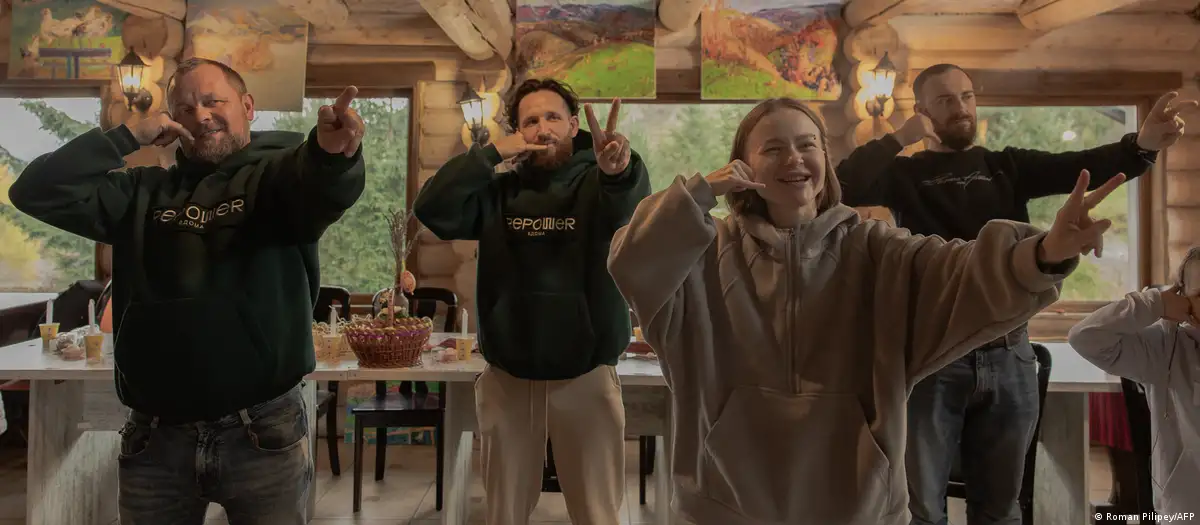
After evening sessions with a psychologist, the medics eat in a local restaurant decorated with mountain paintings and fairy lights. But even this break is dominated by the war. That becomes evident during a game of Alias, where players try to get their teammates to guess random words. "We don't have enough of it," one medic said. "Blood!" the team shouted.