Iran protest crackdown: What are the US's military options?
January 16, 2026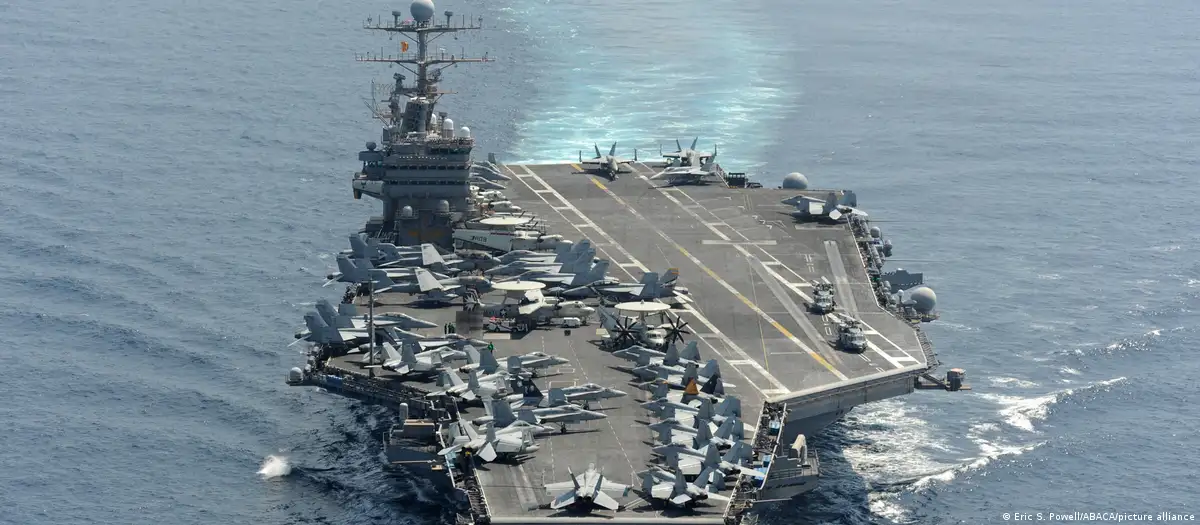
For most of the last two weeks, Donald Trump has been publicly mulling over what to do in Iran. Amid a brutal crackdown on anti-regime protesters in the Islamic Republic, the US president had promised "very strong action" before backing away somewhat on Wednesday having been told by "very important sources on the other side" that "the killing in Iran is stopping."
Such unpredictability is a Trump trademark, but with a US aircraft carrier on its way to the Middle East, US military personnel reportedly being pulled from key bases in the region and the temporary closure of Iranian airspace earlier this week, there are signs that some form of attack could be imminent.
DW asked several experts what the options are for the US in Iran.
Is there a viable military option for the US in Iran?
The answer to this depends largely on what the goals of an attack are, according to former US Marine Corps Colonel Mark Cancian.
"No military attack can stop the Iranian authorities from killing demonstrators. However, the United States could attack security forces, likely the Revolutionary Guards, in order to punish Iran and make a point to the security forces about their vulnerability," said Cancian, who now works at the Center for Strategic and International Studies, a Washington-based think tank.
Ashok Swain, who heads the department of peace and conflict research at Uppsala University in Sweden, agrees that any military involvement must be "limited" and fulfill specific aims such as protecting US troops or allies.
"That typically points to a posture of regional deterrence — air and missile defense, naval protection and clear red lines — combined with very selective, clearly attributable actions when necessary," he said.
Both experts agreed that the use of technology, such as the B-2 stealth bomber and other missiles used in the Operation Midnight Hammer strike on Iranian nuclear sites last June, would not make sense in this case.
"It would be possible, but it is not necessary," said Cancian. "Long-range missiles like the Tomahawk would be effective. The B-2 was used in Midnight Hammer because it alone could carry the specialized bomb for hardened and deeply buried targets."
Swain added that "strikes of that kind are high-stakes, politically defining events, hard to keep limited, easy to misread and likely to invite retaliation against US forces and partners in the region."
What would the potential repercussions be of an attack?
These would, naturally, vary somewhat according to the form any attack takes. But international relations expert Mohammad Eslami from the European University Institute urges caution.
"Any US military action would likely produce minimal strategic gains while dramatically escalating regional instability, exporting insecurity across the Middle East and strengthening Iran's resolve rather than weakening it," he said.
For Swain, anything beyond necessary targeted attacks on a fellow nuclear power with sway in the Middle East could prove costly to the US.
"Anything broader quickly turns into escalation, strengthens hardliners, and exposes civilians to the blowback," he said.
In Cancian's view, these focused missions will likely be the only course of action considered in any case and would attract few serious repercussions. "The United States would not launch attacks near the demonstrators [or] where the confrontations are occurring. It might attack the headquarters and bases of the security forces," he said.
Could the US capture or kill Ayatollah Ali Khamenei?
The capture of Venezuelan leader Nicolas Maduro by US forces earlier this month has been hailed by the Trump administration as a great strategic success. But the experts DW spoke with don't think a similar tactic will likely be used on Ayatollah Ali Khamenei, Iran's supreme leader since 1989.
While Eslami considers that "assassination is theoretically possible," in practical terms, he considers it a non-starter due to "Iran's internal structure, geographic depth and the absolute loyalty of the Sepah-e Vali-e Amr [the covert unit of the Revolutionary Guards] tasked with his protection."
Cancian adds that the nature of the protests and reaction to them means that, even in the unlikely event that such a capture or assassination were possible, the time could not possibly be now.
"The United States does not have the needed forces in place or the weeks of preparation time. This also is a more difficult target, farther from the United States and from the launch point in the Persian Gulf," he said.
What are the non-military options for the US in Iran?
Given the paucity of military options available to the Trump administration, it may be that less dramatic action is the smarter path. Swain said a number of "under-discussed options" are open to the US, including: "financial pressure on specific entities tied to repression, defensive regional moves that reduce Iran's leverage, such as missile defense and maritime security and diplomacy that uses carrots as well as sticks."
He added that supporting the Iranian population in more subtle ways would have a greater impact than is often recognized. "Covert support to civil society and information access usually sits in the background too, but it works best when it's boring, sustained, and credible, not when it is paired with military escalation that lets Tehran paint all dissent as foreign-sponsored."
For Cancian, "restoring the Internet [a communication blackout has now been in place for over a week] would be the most helpful action for the demonstrators. That would allow them to network, share information, and concentrate."
Finally, for Eslami, the fundamental question is whether these are even decisions for the US to make alone. "The only sustainable option is a return to international law, diplomacy, and multilateral institutions. Continued unilateral intervention reinforces instability and follows a post–World War II pattern in which military involvement consistently produces long-term insecurity rather than order," he concluded.